The deepest grid we make. For sites where the build-up is specified, not guessed.
The IBRAN®-X50 is built to the same spec as our shallower grids: same recycled material, same closed-cell base, same 25 year warranty. It just holds a deeper layer of stone, and on the right site that depth is the whole point.
When a drawing calls for 50mm of confined fill. In a stabilised surface it's the stone that spreads the load, not the plastic. A deeper layer spreads it wider before it reaches the sub-base, which is why a 40mm grid can't substitute however strong it is. If someone's done the calculation, this is the grid that matches it.
For traffic that doesn't let up. Access roads, service yards, commercial car parks, emergency routes. The deeper cell holds the stone tighter under turning and braking, so the surface stays flat instead of rutting where the wheels always land.
The best grid for grass. A 50mm cell holds a deeper rootzone: more moisture, more room for roots, and grass that recovers between uses instead of just surviving them. Shallow grids dry out first at the wheel tracks. Ideal for overflow parking, event fields and verge protection.
Fill it with a 6-20mm graded blend, angular and clean. A blend beds in tighter than a single size because the smaller stone fills the gaps. A full cell puts the load through the stone and into the ground, not through the plastic. Skip anything rounded or dusty. For grass, use a sand-based rootzone rather than topsoil.
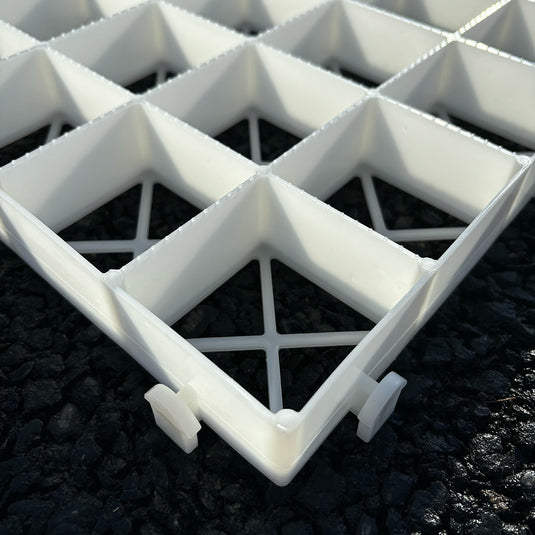
Push-fit, four to the square metre, cuts with a hand saw.
Which depth? IBRAN®-X50 if you're working to a drawing, running sustained commercial traffic, or need grass that properly recovers. IBRAN®-X40 for a standard driveway. IBRAN®-X30 if levels are tight or you're laying over an existing surface.
Specifying? Technical data and the NBS object are available, along with pallet and project pricing. Get in touch.
IBRAN®-X50 50mm Ground Grid Specifications
| Dimensions & Build-Up | |
|---|---|
| Dimensions: | 500mm x 500mm x 50mm |
| Installed Height: | Approx. 70mm including 20mm overfill |
| Grid Coverage: | 4 grids/m2 |
| Cellular Space: | 68mm x 68mm Octagons |
| Ribbed Wall Thickness: | 4mm |
| Weight: | 1035 g/grid |
| Performance | |
| Compression Resistance: | 650 tonnes per m2 |
| Axle Load Capacity: | 35 tonnes |
| Slope Tolerance: | 20% / 11º |
| Temperature Stability: | -50ºC to +90ºC |
| UV Stability: | UV stabilised for permanent external use |
| Fill | |
| Recommended Fill: | 6-20mm graded blend, angular, clean, no fines |
| Fill Quantity: | 40 kg per grid |
| Grass Fill: | Sand-dominant rootzone |
| Installation | |
| Connection: | Push-fit interlocking, no tools or fixings required |
| Cutting: | Hand saw, circular saw or jigsaw |
| Recommended Sub-Base: | 150mm compacted MOT, 10mm sharp sand blinding, non/woven membrane |
| Minimum Excavation: | 210mm (150mm sub-base + 10mm sand + 50mm grid) |
| Material & Compliance | |
| Material: | 100% recycled PP/HDPE |
| Colour: | Black (others available on request) |
| Manufacture: | Made in-house by IBRAN®, full material traceability |
| Drainage: | Fully permeable |
| Compliance: | SuDS compliant |
| Environmental: | Non-toxic, chemically inert & reusable |
| Nature: | Tree safe |
| End of Life: | Returnable to IBRAN for recycling |
| Supply | |
| Pallet Quantity: | 200 grids per pallet (50 m2) |
| Warranty: | 25 years, subject to documented installation |
How the X50 works
A gravel grid is a confinement system. The stone carries the load; the grid holds it in a closed cell so it cannot spread sideways, migrate toward the edges, or rut where wheels land in the same place every day.
That's why depth matters. A deeper cell holds a deeper layer of confined stone, and a deeper layer spreads load across a wider footprint before it reaches the sub-base. At 50mm, the X50 is built for sites where that spread has been calculated rather than assumed.
The moulded X-lattice base closes the underside of each cell, so the fill is retained rather than working its way down into the sub-base over time. Once filled, the whole installation behaves as one confined mass rather than a tray of loose stone.
Specifying the X50
Choose the X50 when:
- A drawing, engineer or consultant has specified a 50mm confined fill layer
- The site sees sustained commercial traffic: delivery vehicles, plant movements, daily service access
- You want design margin on a surface that has to stay flat for decades
- Grass has to genuinely recover between uses rather than just survive being parked on
The X40 remains the right choice for standard domestic driveways. The X30 is for sites where finished levels are constrained or you're laying over an existing hard surface. Specifying more depth than the site needs is stone you've paid to bury.
Technical data, the NBS BIM object and installation documentation are all available for specification work. Contact us for project and pallet pricing.
Choosing your stone
Fill with a 6-20mm graded blend: angular, clean, free of fines.
Most guidance in this industry recommends a single stone size. It's simple advice, and it leaves voids. Uniform particles bridge against each other, so no matter how carefully you lay them, the cell never packs solid. Those voids are space the stone settles into later, which is why single-size installations so often need topping up in the first year.
A graded blend fills them. Smaller stone wedges into the gaps between the larger, and the cell packs tight from the first pass.
This matters more than it sounds. A fully bedded cell transfers load through the stone and into the ground beneath it. A partially filled cell transfers load through the plastic cell walls instead. The stone should be doing the work, and a blend is what lets it.
Two things to avoid. Rounded shingle rolls rather than interlocking, however well graded. And anything carrying fines, dust or scalpings will bind the surface, shedding water across the top instead of through it, and giving weeds somewhere to establish. When ordering, ask your merchant for washed graded aggregate and be explicit that you don't want as-dug material.
Using the X50 for grass
The same cell, filled with rootzone instead of stone.
Depth does more for grass than most people expect. A 50mm profile holds more moisture below the surface and gives roots more room to establish before they hit anything solid. Shallow grids dry out fast in summer, and the sward fails first at the wheel tracks, which is exactly where it needs to survive.
The extra depth also sets the grid top slightly below the growing crown. Mowers pass over cleanly, and the finished surface reads as lawn rather than as plastic with grass growing through it.
Fill with a sand-dominant rootzone rather than topsoil alone, so the profile stays free-draining under compaction. Well suited to overflow car parks, event fields, emergency access routes, verge protection and any grass surface that needs to look like grass when it isn't being driven on.
Installation
Grids are pushed together by hand: no tools, no fixings, no adhesive. Orientate every grid the same way, work one row at a time, and interlock as you go. Perimeter grids cut cleanly with a hand saw or jigsaw.
On a new build-up, allow 210mm minimum excavation: 150mm of compacted sub-base, 10mm sharp sand blinding, and the 50mm grid, with stone overfilled proud of the cells.
On an existing concrete or tarmac surface, fill any holes first and use ramp edging at the entrance, bolted down with 12mm expansion bolts. Edge restraint matters on any open side: without it, the outer grids take load they weren't designed to take alone.
Overfill slightly and let traffic settle the surface, or run a whacker plate over it to bed the fill immediately. With a graded blend, the stone largely beds itself.
Full step-by-step instructions are in our gravel grid installation guide.
Drainage and permeability
The surface stays fully permeable. Water passes through the fill, through the open cell base and into the ground below, so a stabilised gravel or grass surface built on the X50 supports SuDS requirements and takes surface water out of the run-off calculation.
That only holds if the fill is clean. Fines are what turn a permeable surface into an impermeable one, which is the practical reason the stone spec matters as much as the sub-base does.
Maintenance
Very little. Correctly filled, the surface shouldn't need routine topping up: the stone hasn't gone anywhere, it's confined. Check levels after the first winter, top up any cells that have settled, and that's usually the last of it.
Individual grids can be lifted if you need access to whatever is underneath, then reinstated.
Material and end of life
Made in-house in the UK from 100% recycled polypropylene and HDPE, with full material traceability from feedstock to finished grid. Non-toxic, chemically inert, and UV stabilised for permanent external use.
IBRAN was founded in 2014 on the conviction that plastic waste is a raw material nobody was treating like one. Every X50 grid keeps post-consumer plastic locked into a product with a service life measured in decades. At end of life, grids can be returned to us for recycling.
25 year warranty, subject to documented installation.
Haili Branson
OnlineTrusted by Industry Leaders









Built for the jobs you sign your name to
If you're staking your reputation on a surface, you need to know it will still be flat in ten years. The X50 is the grid we make for sites where that isn't negotiable.
- Impact-modified recycled polypropylene that doesn't crack under plant or frost, so grids survive the site as well as the surface.
- A closed cell base that holds the fill as a solid tray. The stone can't work its way underneath, so the surface doesn't lift or rut where the wheels always land.
- Push-fit from above, no tools and no fixings. Two people can lay hundreds of square metres in a day.
- Works with the rest of the system: ramp edging, border edging and bay markers all connect straight onto the grid.
- 25 year warranty and a spec sheet you can hand to a client or a consultant.
Trade pricing, pallet rates and priority dispatch are available through TradeHub, along with technical support when a job needs it.
Proudly put your name behind it.